Braille Numbers
How the numeric indicator turns the first ten letters into digits, and what happens with dates, times, decimals and fractions.
Last updated
Braille has no separate cells for digits. A number is the numeric indicator ⠼ (dots 3-4-5-6) followed by the letters a to j, which then stand for the digits 1 to 9 and 0 (ICEB 6.1). One indicator covers the whole run of digits, with any full stops and commas inside it; a space, a colon or a slash ends the number (ICEB 6.2.1, 6.3.1). So 15 is ⠼⠁⠑: the indicator, a for 1 and e for 5.
The ten digits
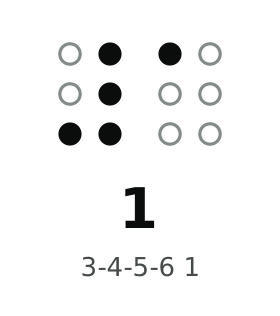
Each digit is two cells: the numeric indicator, then one of the letters a to j. Without the indicator in front, the second cell reads as that letter.
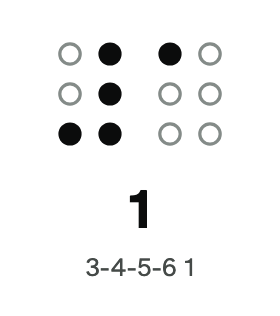
- 1 dots 3-4-5-6 1 the letter a
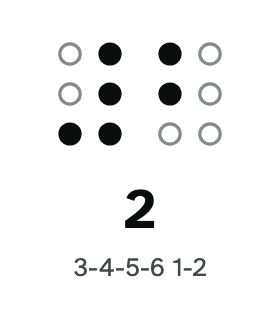
- 2 dots 3-4-5-6 1-2 the letter b
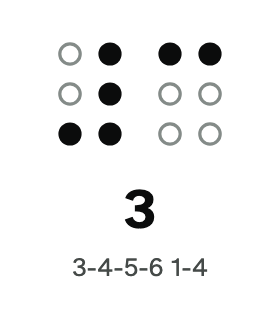
- 3 dots 3-4-5-6 1-4 the letter c
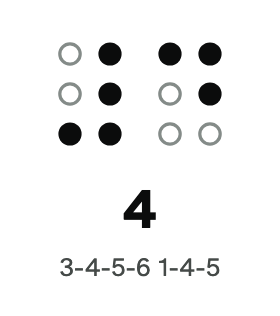
- 4 dots 3-4-5-6 1-4-5 the letter d
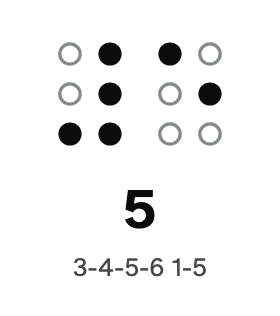
- 5 dots 3-4-5-6 1-5 the letter e
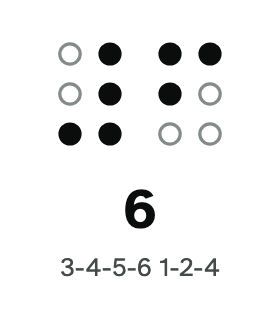
- 6 dots 3-4-5-6 1-2-4 the letter f
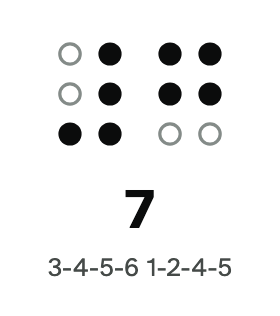
- 7 dots 3-4-5-6 1-2-4-5 the letter g
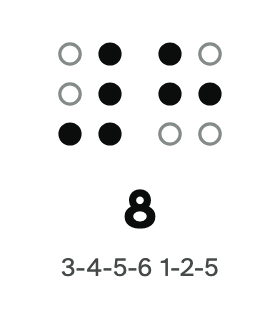
- 8 dots 3-4-5-6 1-2-5 the letter h
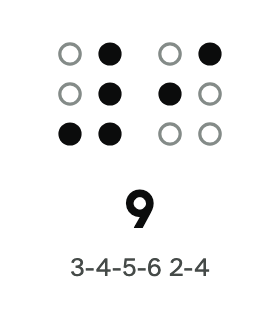
- 9 dots 3-4-5-6 2-4 the letter i
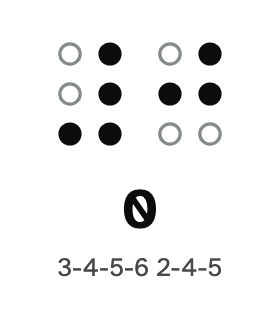
- 0 dots 3-4-5-6 2-4-5 the letter j
The numeric indicator ⠼ (dots 3-4-5-6) turns the letters a to j after it into the digits 1 to 9 and 0. (ICEB 6.1)
- dots 3-4-5-6numeric indicator
- dots 1a, read as 1
- dots 1-5e, read as 5
One indicator for the whole number
One numeric indicator covers the digits, full stops and commas after it. A space and most other signs end the number, so after the colon in a time or the slash in a date the digits take a new numeric indicator. (ICEB 6.2.1, 6.3.1)
Every example on this page is liblouis 3.39.0 output in Grade 2. Numbers come out the same in Grade 1.
| Braille and what to notice | |
|---|---|
| 2026 | dots 3-4-5-6 1-2 2-4-5 1-2 1-2-4 One numeric indicator, then four digits. |
| 1,000,000 | dots 3-4-5-6 1 2 2-4-5 2-4-5 2-4-5 2 2-4-5 2-4-5 2-4-5 Commas inside the number keep it going. |
| 3.75 | dots 3-4-5-6 1-4 2-5-6 1-2-4-5 1-5 The decimal point is the full stop, ⠲ (dots 2-5-6). |
| 3/4/2026 | dots 3-4-5-6 1-4 4-5-6 3-4 3-4-5-6 1-4-5 4-5-6 3-4 3-4-5-6 1-2 2-4-5 1-2 1-2-4 Each slash, ⠸⠌ (dots 4-5-6, 3-4), ends the number, so the next digits start again. |
| 10:30 | dots 3-4-5-6 1 2-4-5 2-5 3-4-5-6 1-4 2-4-5 The colon ends the number, so the minutes take their own indicator. |
| pages 4–7 | dots 1-2-3-4 1 1-2-4-5 1-5 2-3-4 / 3-4-5-6 1-4-5 6 3-6 3-4-5-6 1-2-4-5 A dash ends it too. |
| 555-0123 | dots 3-4-5-6 1-5 1-5 1-5 3-6 3-4-5-6 2-4-5 1 1-2 1-4 So does a hyphen: each group of a phone number starts again. |
Letters after a number
The numeric indicator also sets grade 1 mode. Straight after a digit, a full stop or a comma, only a lowercase letter a to j needs the grade 1 indicator ⠰, because it would otherwise read as a digit. (ICEB 6.5)
While the grade 1 mode set by a number lasts, the letters after it are not contracted, so 1st is written with s and t rather than the st sign. (ICEB 6.5.3) A space, hyphen or dash ends the grade 1 mode a number sets. After a hyphen, a letter that could be read as a contraction takes the grade 1 indicator. (ICEB 6.5.1, 6.5.4)
| Braille and what to notice | |
|---|---|
| room 12b | dots 1-2-3-5 1-3-5 1-3-5 1-3-4 / 3-4-5-6 1 1-2 5-6 1-2 b would read as the digit 2, so it takes the grade 1 indicator ⠰ (dots 5-6). |
| 3m | dots 3-4-5-6 1-4 1-3-4 m is not one of a to j, so it needs no indicator. |
| Room 3A | dots 6 1-2-3-5 1-3-5 1-3-5 1-3-4 / 3-4-5-6 1-4 6 1 A capital cannot be a digit, so it needs no indicator. |
| 7a.m. | dots 3-4-5-6 1-2-4-5 5-6 1 2-5-6 1-3-4 2-5-6 Only the a, straight after the 7, needs the indicator. |
| 1st | dots 3-4-5-6 1 2-3-4 2-3-4-5 No contractions after a number: s and t, not the st sign. |
| 2nd | dots 3-4-5-6 1-2 1-3-4-5 1-4-5 n is not one of a to j, so it follows the digit with no indicator. |
| 6-CD | dots 3-4-5-6 1-2-4 3-6 5-6 6 6 1-4 1-4-5 After the hyphen, CD takes the grade 1 indicator so it does not read as a contraction. |
Fractions
A fraction printed as one character, such as ½, uses the simple fraction line ⠌ (dots 3-4), which keeps numeric mode going. A fraction printed with a slash, such as 1/2, keeps the slash ⠸⠌, so the number after it takes a new numeric indicator. (ICEB 6.2.1, 6.3.1, 11.3.1)
| Braille and what to notice | |
|---|---|
| ½ | dots 3-4-5-6 1 3-4 1-2 One print character: the fraction line ⠌ (dots 3-4) and one numeric indicator. |
| 1/2 | dots 3-4-5-6 1 4-5-6 3-4 3-4-5-6 1-2 Typed with a slash: the slash stays, and the 2 starts again. |
| 2½ | dots 3-4-5-6 1-2 3-4-5-6 1 3-4 1-2 A mixed number is the whole number and the fraction written together. |
Money, percentages and the # sign
Currency signs go where print puts them (ICEB 3.10), and so does the percent sign. The # sign and the numeric indicator are different signs; the number sign on the punctuation page shows both.
| Braille and what to notice | |
|---|---|
| $4.50 | dots 4 2-3-4 3-4-5-6 1-4-5 2-5-6 1-5 2-4-5 The dollar sign comes first, as in print. |
| 50% | dots 3-4-5-6 1-5 2-4-5 4-6 3-5-6 The percent sign ⠨⠴ (dots 4-6, 3-5-6) follows the number. |
| #1 | dots 4-5-6 1-4-5-6 3-4-5-6 1 The print # is ⠸⠹ (dots 4-5-6, 1-4-5-6), a different sign from the numeric indicator. |
Numbers with spaces between digit groups
When print groups the digits of one number with spaces, UEB writes each of those spaces as dot 5, so the whole number needs only one numeric indicator. (ICEB 6.6.1)
liblouis 3.39.0 treats every space as a word space, so a number printed with spaces between digit groups comes out as separate numbers. (engine) If the digits belong to one number, check that part by hand, or write the number with commas.
The engine writes “4 500 000” as three numbers:
What this page does not cover
- Maths notation, whether in UEB technical material or in Nemeth Code. Our translator handles numbers in ordinary text only.
- Spaced digit groups, such as 4 500 000. The engine splits them into separate numbers, as numbers with spaces shows.
Number images for worksheets
Free for worksheets, labels and teaching materials if you credit “UEB Translator (uebtranslator.com)”, under the CC BY 4.0 licence. Printed in ink, they are for sighted readers and cannot be read by touch.
Show all 10 images, as SVG or PNG
1SVG of the number 1PNG of the number 1 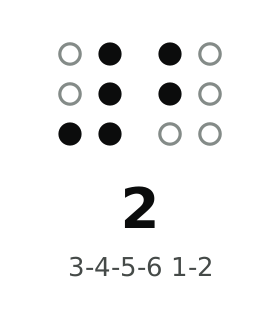
2SVG of the number 2PNG of the number 2 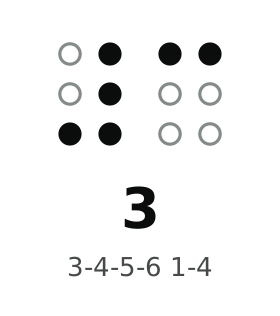
3SVG of the number 3PNG of the number 3 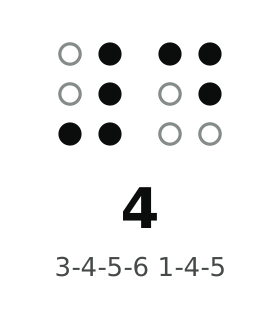
4SVG of the number 4PNG of the number 4 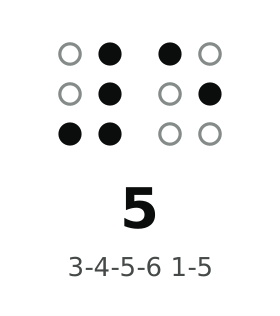
5SVG of the number 5PNG of the number 5 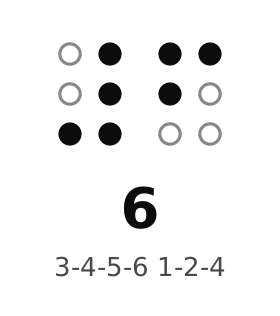
6SVG of the number 6PNG of the number 6 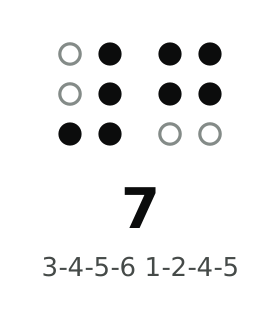
7SVG of the number 7PNG of the number 7 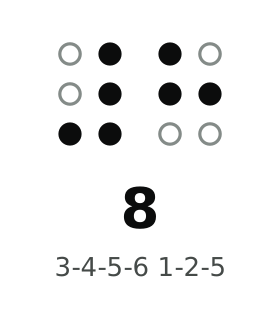
8SVG of the number 8PNG of the number 8 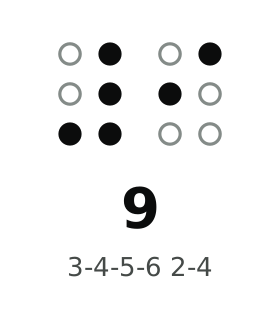
9SVG of the number 9PNG of the number 9 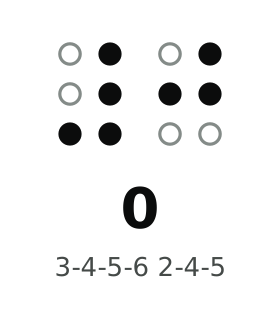
0SVG of the number 0PNG of the number 0
Questions
Why does the numeric indicator appear more than once in a date?
Only digits, full stops and commas continue a number. The slash in 3/4/2026 ends it, so the 4 and the 2026 each start again with ⠼ (dots 3-4-5-6).
How do I show a letter straight after a number?
Only a lowercase a to j needs help, because it would read as a digit: it takes the grade 1 indicator ⠰ (dots 5-6). Examples are under letters after a number.
Is the numeric indicator the same as the # sign?
No. The numeric indicator ⠼ (dots 3-4-5-6) starts a number. The print symbol # is ⠸⠹ (dots 4-5-6, 1-4-5-6); see the number sign on the punctuation page.
How is a decimal point written?
With the full stop ⠲ (dots 2-5-6). Inside a number it keeps the number going, so 3.75 needs only one numeric indicator.
Rules: Rules of Unified English Braille, Third Edition 2024, cited by section number. Braille examples come from liblouis 3.39.0. All sources and when they were checked